ECML PKDD 2026 · Naples Cooperative Reasoning Programming-by-example Neuro–Symbolic

Beyond Either-Or Reasoning:
Transduction and Induction
as Cooperative Problem-Solving Paradigms

Janis Zenkner  ·  Tobias Sesterhenn  ·  Christian Bartelt

Clausthal University of Technology, Clausthal-Zellerfeld, Germany

Overview

Two Paradigms, One Trajectory

Programming-by-example (PBE) has long been approached through one of two lenses. The inductive approach searches over a symbolic program space to find a reusable program consistent with the provided input-output examples. The transductive approach treats the examples as context and predicts missing outputs directly, without ever constructing a program artifact.

Both paradigms succeed — but they fail on systematically different tasks. Induction excels at compositional, logically precise transformations; transduction excels at fluid pattern-matching where explicit rule construction stalls. This complementarity holds not just across tasks, but at the level of individual reasoning steps within the same solution trajectory.

The Problem with Existing Combinations

Current hybrid approaches — such as ExeDec — use transductive predictions to pre-determine the full solution trajectory. The inductive synthesizer is then constrained to reach each transductively fixed next state, retaining only local search autonomy. When a transductive prediction is wrong, the error propagates irrecoverably: induction cannot deviate to find a globally consistent solution, even if one exists.

Four paradigms — one solution trajectory
State from program execution
State from neural prediction
Inductive Full inductive control
s₀
p₁
s₁
p₂
s₂
p₃
s₃
p₄
s₄

Every transition is an inductive step. The synthesizer holds full trajectory autonomy but suffers from combinatorial explosion as program length grows.

Transductive Full transductive control
s₀
M
s₁
M
s₂
M
s₃
M
s₄

All states are predicted by the neural model M (dashed = transductively determined). No symbolic program is produced; no reusable artifact results.

Hybrid (ExeDec) Transductively fixed, inductively realised
s₀
p₀
s₁
p₁
s₂
p₂
s₃
p₃
s₄

Target states are pre-determined by transduction (dashed). Programs pi realise each fixed subgoal but induction cannot deviate — one wrong M prediction poisons the entire trajectory.

Cooperative (TIIPS) Both paradigms co-determine the trajectory
s₀
p₀
s₁
p₁
s₂
p₂
s₃
p₃
s₄

Inductive (solid, pi) and transductive (dashed, M) steps interleave freely. After each M-step, fsyn recovers full search autonomy — the prediction is a springboard, not a blueprint.

We propose cooperative transductive-inductive problem solving: both paradigms interleave dynamically along the trajectory, with neither unconditionally controlling it. Each transductive prediction acts only as a search horizon reset, not a blueprint the inductive solver is forced to follow.

+10 pp
over ExeDec on DeepCoder
avg. across all categories
221
tasks solved exclusively by TIIPS
unreachable by any ensemble
+13 pp
over ExeDec on LambdaBeam
avg. across all categories
Contributions

What We Contribute

1

A General Cooperative Framework

A formal definition of cooperative transductive-inductive problem solving, with three necessary criteria (Dual Agency, Interleaved Granularity, Search Autonomy Preservation) that distinguish genuine cooperation from ensemble and subordination approaches. The framework is paradigm-agnostic and applies to any system where symbolic and neural reasoners share a state space.

2

TIIPS — a Proof-of-Concept Instantiation

Transductively Informed Inductive Program Synthesis, which uses transduction as a search horizon reset rather than a trajectory blueprint. The incremental intervention schedule recovers the inductive baseline at j = 0 and ExeDec at j = J, isolating all performance gains to the cooperative regime 0 < j < J.

3

The Cooperative Dividend

Empirical evidence that TIIPS solves tasks unreachable by any ensemble of ExeDec and the inductive baseline — directly validating Search Autonomy Preservation and ruling out both the prefix-of-ExeDec and ensemble explanations for TIIPS's gains.

4

Robustness Beyond Accuracy

TIIPS not only solves more tasks but more frequently recovers the intended program — higher intent match and syntactic overlap with ground truth. Cooperative solvers are not just more powerful than their components; they are more reliably correct.

Cooperative Framework

What Makes a Combination Truly Cooperative?

We formalize problem solving as navigation through a state space S. At every state st, a solver can take an inductive transition — synthesizing a symbolic program fragment — or a transductive transition — using a neural model to leap directly to the next state. An approach qualifies as cooperative if and only if it satisfies three criteria:

1

Dual Agency

Both paradigms function as active problem-solvers. Neither exists solely to constrain, sketch, or pre-process the output of the other. This rules out approaches where induction serves only as a data-augmentation step, or where transduction is merely a feature extractor.

2

Interleaved Granularity

The system permits switching between paradigms at the level of individual reasoning steps — not only at task initialization or termination. This rules out ensemble approaches, where the two paradigms run in parallel and never interact within a single solution trajectory.

3

Search Autonomy Preservation

After a transductive transition, the new state becomes a fresh search root from which either solver explores the full program space, unconstrained by further consistency requirements. Each transductive step is a search horizon reset — bypassing a syntactic bottleneck without irrevocably pruning the paths that follow.

Why This Matters

Any system satisfying these three criteria qualifies as cooperative, regardless of how switching is scheduled or which models instantiate them. The framework is paradigm-agnostic — its implications extend beyond PBE to any setting where bounded symbolic and neural reasoners operate over a shared state space.

Instantiation

TIIPS: Transductively Informed Inductive Program Synthesis

TIIPS is a proof-of-concept instantiation of the cooperative framework that maintains interpretability by preserving the terminal objective of producing an explicit symbolic program. It pairs an inductive synthesizer fsyn with a transductive guide fgui, both implemented as Transformer encoder-decoders. The key mechanism is an incremental intervention schedule: for increasing numbers of guided prefix steps j = 0 … J, the transductive guide sets the subtask target for the first j steps while fsyn reasons freely over the remaining steps — each guided state acting as a new search root, not a fixed constraint. For full algorithmic and architectural details, see the paper.

Key Distinction from ExeDec

In ExeDec, fgui pre-determines the full trajectory before synthesis begins. In TIIPS, each call to fgui influences only the immediate next subtask. Once the inductive synthesizer reaches that state, it explores the full program space from there with no further prescription. The transductive prediction is a springboard, not a cage. j = 0 recovers the pure inductive baseline; j = J recovers ExeDec — all gains come from the cooperative regime in between.

Experimental Setup

Three Domains of Increasing Complexity

Domains are chosen to vary the structural property that matters most for cooperative reasoning: the degree of decomposition ambiguity, and the reliability of transductive guidance. All models share identical architectures and weights across conditions; the only variable is the interaction paradigm.

List Domain

DeepCoder

Integer list transformations via first- and higher-order functions (Map, Filter, Scanl1…). Multiple valid programs and decompositions exist per task, giving cooperative reasoning room to outperform subordination.

Extended List

LambdaBeam

Extends DeepCoder with dynamically constructed lambda functions and a conditional If operation. Branching paths amplify the cost of a single wrong transductive prediction — and correspondingly amplify cooperative gains.

String Domain

RobustFill

String transformations with a DSL covering substring extraction and modification. Decomposition order is structurally fixed — each task has a single canonical solution trace. Designed to produce convergence between TIIPS and ExeDec, validating the cooperative framework's prediction.

Evaluation Protocol

5 random seeds · 1,000 test tasks per seed and category · beam size 10 · leave-one-out (LOO) protocol · 5 compositional generalisation categories: in-distribution, length generalisation, compose different concepts, switch concept order, compose new operation, add operation functionality. TIIPS and ExeDec make identical total model calls per task. Architecture: Transformer, embedding dim 512, hidden dim 1024, 3 layers, 4 attention heads. Training: single RTX A6000, ~1 day per category.

Results

TIIPS Outperforms Across the Board

TIIPS consistently outperforms both the inductive baseline and ExeDec across DeepCoder and LambdaBeam, in all five compositional generalisation categories. All TIIPS vs. ExeDec differences are statistically significant (paired t-test, p < 0.05). In RobustFill — a single-trace domain with structurally fixed decomposition order — TIIPS and ExeDec converge, exactly as the cooperative framework predicts.

DeepCoder — Task Accuracy (%)
LambdaBeam — Task Accuracy (%)
TIIPS
ExeDec
Ind. Baseline

The Cooperative Dividend

TIIPS solves a substantial set of tasks that are unreachable by either baseline individually or in combination — ruling out both the ensemble and prefix-of-ExeDec explanations. The Venn diagrams below show the overlap of solved tasks (DeepCoder left, LambdaBeam right).

DeepCoder — Solved Tasks Overlap
LambdaBeam — Solved Tasks Overlap

Robustness: Intent Match & Syntactic Overlap

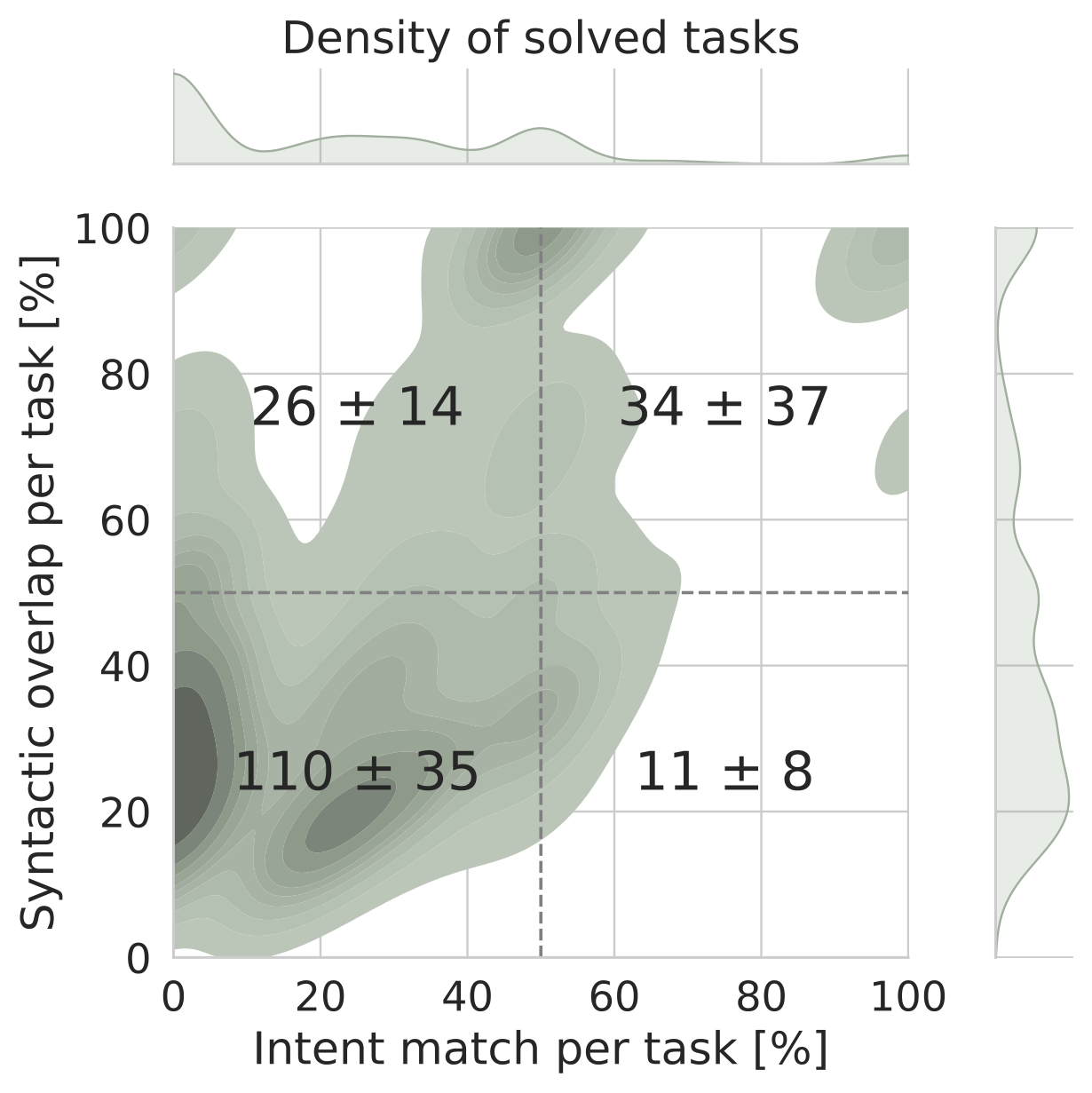
Beyond accuracy, TIIPS solutions concentrate in the high intent match / high syntactic overlap quadrant — matching the intended program behavior, not just the training examples. ExeDec solutions spread across lower quadrants: a fingerprint of the subordination failure mode, where a slightly off-target transductive prediction forces the synthesizer to produce convoluted programs that satisfy the examples but deviate from the canonical transformation.
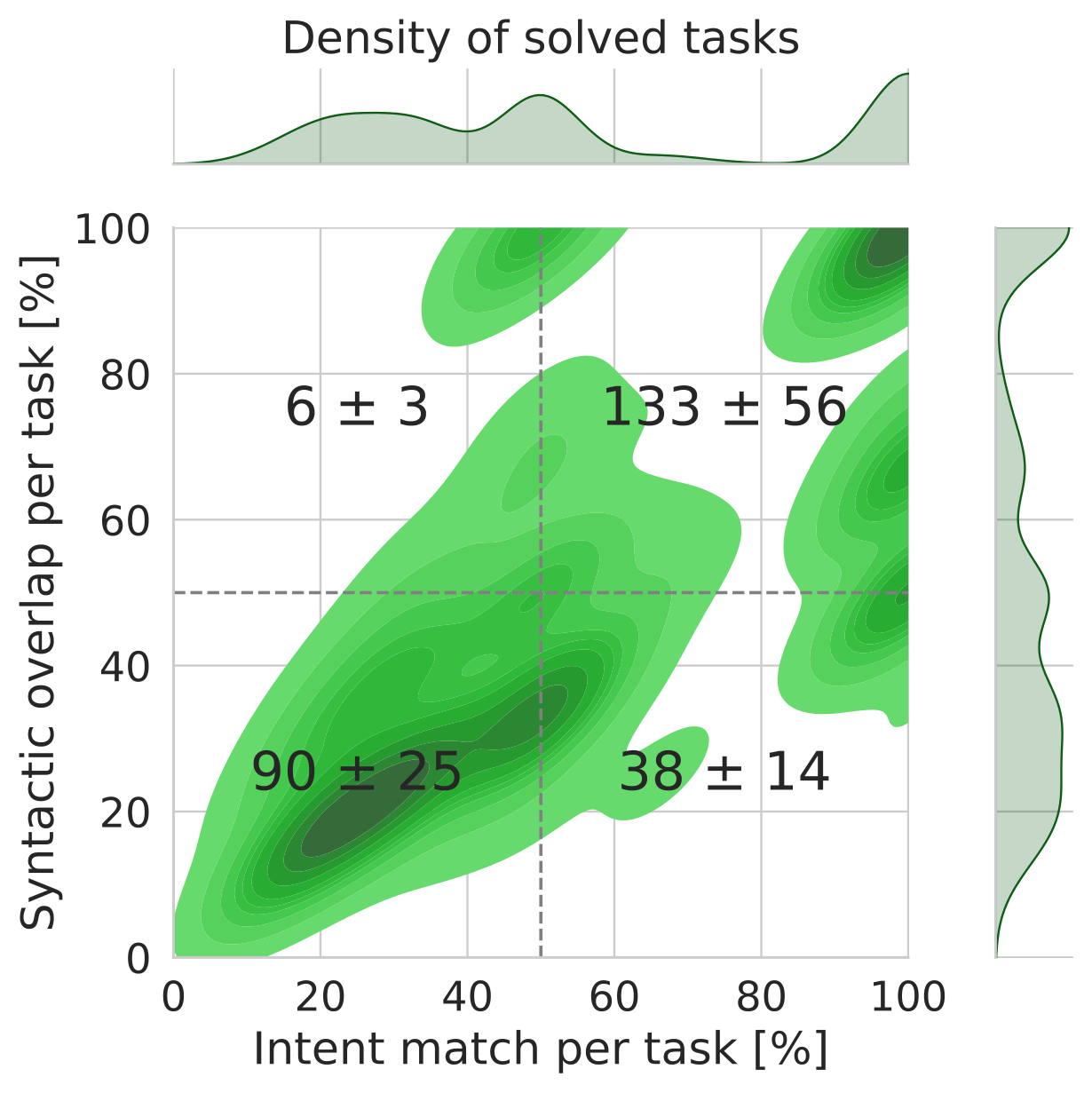
LambdaBeam — TIIPS
Density of solved tasks — TIIPS on LambdaBeam
LambdaBeam — ExeDec
Density of solved tasks — ExeDec on LambdaBeam
Cite

Citation

Accepted at ECML PKDD 2026, Naples. Please cite the conference version when available.

@inproceedings{zenkner2026tiips, title = {Beyond Either-Or Reasoning: Transduction and Induction as Cooperative Problem-Solving Paradigms}, author = {Zenkner, Janis and Sesterhenn, Tobias and Bartelt, Christian}, booktitle = {Proceedings of the European Conference on Machine Learning and Principles and Practice of Knowledge Discovery in Databases (ECML PKDD)}, year = {2026} }